Ronda is parked near the campground bulletin board. I apologize to her for being 15 minutes late. She tells me not to worry, and that she arrived 30 minutes early because she was concerned about traffic on the winding country roads of southwest Washington. I’m embarrassed for making someone I’ve never met drive an hour and a half to meet a couple of middle-aged urbanites at a trailhead in the middle of nowhere, but after loading our packs into the back of her car and learning about her life in the small community of Trout Lake, it’s obvious that Ronda is a genuinely caring person — a true trail angel — who is happy to help us on our journey.
One of the challenges of section hiking the PCT is setting up the shuttles. Most of our backpacking trips are loops because starting and ending at the same place makes transportation simple. But hiking a fifty-mile transect along the spine of the Cascade Mountains is trickier. There are only a handful of road crossings in the entire 500 miles of the PCT in Washington State. Thankfully, there is an active group of Trail Angels in Trout Lake, which is how we found Ronda. There are currently thirteen of them listed on the Trail Angels of Trout Lake webpage, which for a town of 720 is pretty impressive. Ronda was the first to accept, and as she drives us the two hours from Panther Creek to Road 23, we learn all about her life, which in the interest of privacy I will not share here. However, I will mention that her grandfather built a fire lookout on the summit of Mt Adams in the 1920s. He and one other guy carried all the supplies (including a potbellied stove) on their backs from the tree line to the top of the mountain. As a reference, Gio and I are carrying 25-pound packs and will be spending the next four days ambling along a trail that never exceeds a 10% grade. There are streets in downtown Seattle steeper than that.
We say our goodbyes to Ronda at the Road 23 trailhead and begin hiking south back to our car around 1:30 pm. Despite the dense forest, the air is hot. At the trailhead, we meet two women who are hiking in the same direction we are. They have done the rest of the Washington PCT but missed this section last year when one of them got sick.
“Be ready for the bugs,” one of them says.
“Yeah?” Gio asks.
“If you’re not a blood donor now, you will be by the end of the weekend,” she says without smiling and then heads off into the woods to join her friend.
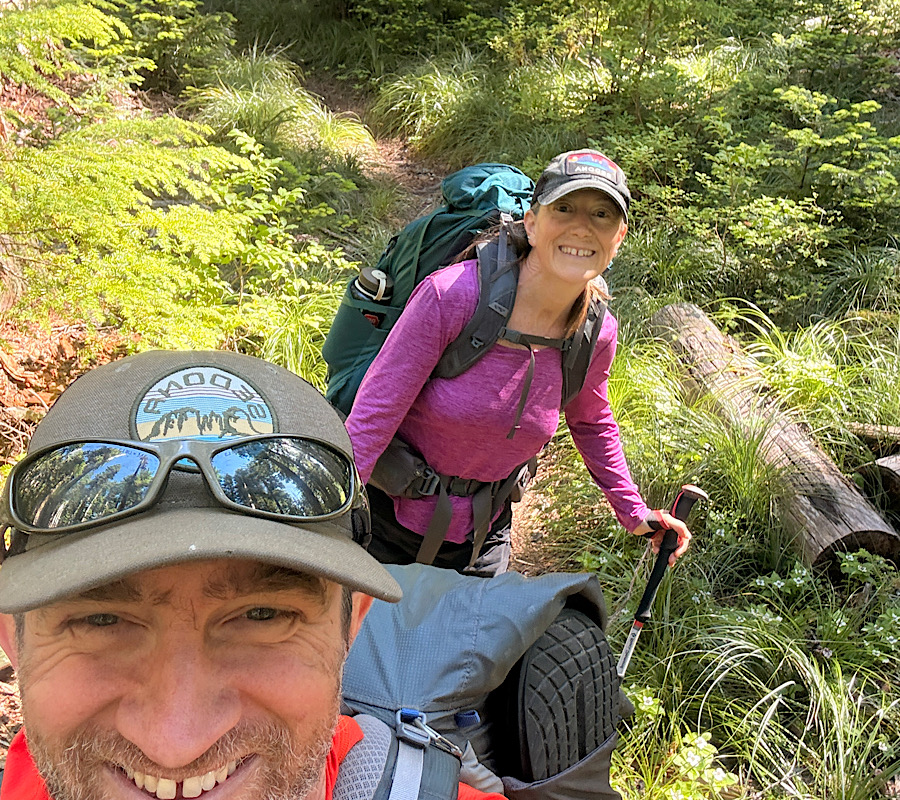
The first day is mostly a long, winding stroll through second-growth conifer forests. Lots of Douglas firs (Pseudotsuga menziesii) and western hemlocks (Tsuga heterophylla). We camp near a stream by Big Mosquito Lake. The area lives up to its name, and we were thankful for having packed our head nets. We cook our dinner on the creosoted bridge that runs over the creek, and as we tuck into our freeze-dried beef stew, a long-tailed weasel (Mustela frenata) runs over a log in front of us.
Weasels fall into the category of really adorable-looking mammals that have an awful reputation for very good reason. I hate to anthropomorphize, but by all measures they are complete assholes. They are territorial, vicious, and downright nasty. Some of this comes from their need to eat 30% of their body weight every day. That’s like me eating 60 pounds of food. And not rice and beans either. They’re obligate carnivores, which means they must kill…a lot, which they are quite good at. They are capable of taking out animals ten times their size. That’s like me taking out a polar bear with nothing but my hands, feet and teeth. I know they sound cool, but before you go romanticizing weasels too much, they are also prone to cannibalism. That’s like me…actually, I think we all get the point.
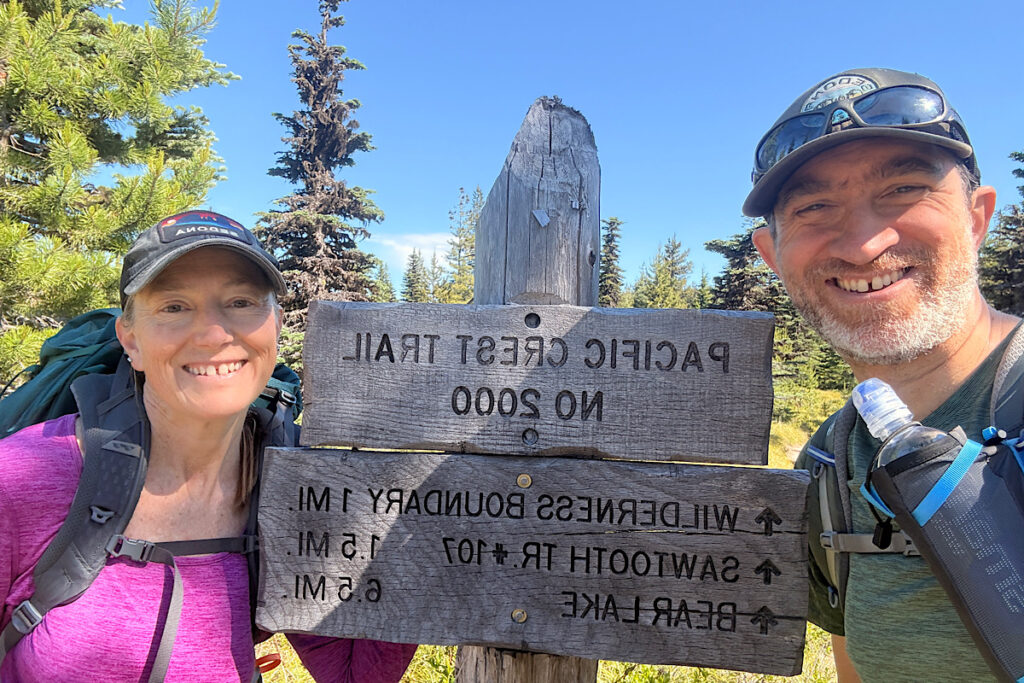
The next day leads us into the Indian Heaven Wilderness, a 20,000-acre wild area perched atop a high, forested plateau. The terrain was formed as lava flowed out of several volcanic cones, whose remnants are still visible from the higher ridge lines. The variety of trees is greater here. Western white pines and Engelmann spruce are common in the drier areas. The area is of cultural significance to several tribes, including the Yakama, Klickitat, and Umatilla. For the last 9,000 years, people have spent summers in the area collecting berries, hunting deer and elk, and fishing in the more than 150 lakes. They must have been some seriously tough mofos, because as far as I can tell, the whole area is one massive breeding ground for mosquitoes. From the moment we step foot into the wilderness, we are swarmed by a constant cloud of skeeters. We drench ourselves in bug spray. We put on our raincoats. The winged vampires are not deterred.
Thinking that the mosquitoes can’t bite us when we’re underwater, we stop for a swim at Bear Lake. The breezes around the lake also keep them at bay, and we enjoy lounging in the sun along the lakeshore. But eventually, we have to get back on the trail and are attacked once again. We meet a retired schoolteacher who is wearing a mosquito net suit. To say he looks ridiculous would be an understatement (it’s like he’s stapled window screens to his body), but as the day continues and we get deeper into the wilderness, I can’t help but think the guy is onto something.
We tell the guy that we’re planning to camp at Blue Lake and ask if there might be a breeze.
“Don’t you worry,” he says. “There will be a breeze.”
Relieved that we won’t be as brutalized at our campsite, we hike another hour to Blue Lake admiring the meadows of white avalanche lilies (Erythonium montanum) that cover the hillsides. These dainty little flowers are common between Mt. Hood and Mt. Rainier, while north and south of that, the yellow glacier lilies (Erythonium grandifolium) tend to dominate. Both of these flowers have the impressive ability to melt early-season snow, making them some of the first plants to be pollinated each spring. Avalanche lily bulbs, leaves, and flowers are all edible, though they must be prepared properly in order to avoid nausea, vomiting, and diarrhea (I’ll stick to the trail mix). And glacier lilies are an important part of the diet for grizzly bears.
We also encounter many western toads (Anaxyrus boreas), many the size and shape of quarters, and a few cascade frogs (Rana cascadae). If you’re wondering what the difference is between a toad and a frog, basically, frogs spend most of their time in the water and are consequently a lot more streamlined. Toads are really land dwellers, with dry, warty skin, and many have a parotoid gland behind their eyes that secretes a nasty toxin. If you’ve heard of people getting high licking toads, that’s probably what did it.
Blue Lake is busy. Several of the campsites are already occupied. The prime site, perched on a little peninsula, seems to have the best breeze, but it’s been taken by a family of four who schlepped in enough gear to furnish the average American living room. They have started a fire to keep the mosquitoes at bay, and even then, their teenage son has completely given up and has been lying in a fetal position inside their tent for most of the afternoon. His younger brother seems to be less bothered by the swarming bugs and whittles a stick next to the fire.
We set up camp and decide to take another swim at a small beach on the north side of the lake. Two women, roughly our age, have been fishing there for much of the afternoon. When we arrive, they have mostly packed up their gear and are getting ready to leave. They are impressed that we’re willing to get in the water. We begin a pleasant conversation and learn they are friends from the Seattle area. One even took classes at my college when she was younger. However, after about ten minutes they still haven’t left and we’re all getting eaten alive.
Not knowing what else to do, I politely ask, “Would you two mind if I got naked?”
They both laugh and say they’re totally fine with it. Though when I start unbuttoning my pants, they certainly speed up their packing.
Our sore muscles appreciate the cold, refreshing water, and the breeze across the surface of the lake keeps the mosquitoes down. One of the women says we should be careful because she lost a lure right where we’re swimming. Giovannina finds it stuck to a log. I dive and haul the log to the surface, being careful to get it hooked on any…body parts. I’m able to remove the lure and toss it to the women on the beach. They are thankful and happy that I didn’t have to get out of the water to give it to them.
Dinner is buggy. It’s impossible to eat with the head nets on, so the back of my neck becomes pocked with mosquito bites. By 7pm we are in the tent and listening to an audiobook. The tent doors are inundated with mosquitoes. At one point I count 50 on my side alone.
I awake around 7 am the next morning to the sound of a freight train rushing through the campground. Wind. It must be blowing 40 mph outside. Our ultralight, single-walled tent holds up surprisingly well, but we’re camped in the middle of a forest and I can’t help but envision a falling branch spearing us like a kebab.
I get up and start the morning routine. With that kind of wind, there are no mosquitoes to be found, which is a nice surprise. But the wind is also really, really cold. The thermometer has dropped about 30 degrees from the day before. Blue Lake sits in a sort of saddle between Gifford Peak and East Crater. The weather systems from the coast must just funnel through there, producing these big winds. When Mosquito Net Guy told us there would be a breeze at Blue Lake, he wasn’t kidding.
We pack up camp, eat some hot oatmeal, and hit the trail by around 10 am. Other than it being a little chilly, the hiking conditions are ideal. There are no bugs to speak of; the air is dry and once we’re away from Blue Lake, there really isn’t any wind.
South of the Indian Heaven Wilderness, we hike along ancient lava flows. There are reportedly thousands of lava caves in the area, though most of them are unmapped. I once hiked down into the famous Guler Ice Cave, which was both spooky and magical. Not being one for tight spaces, I prefer walking on a trail to squeezing between rocks in the dark.
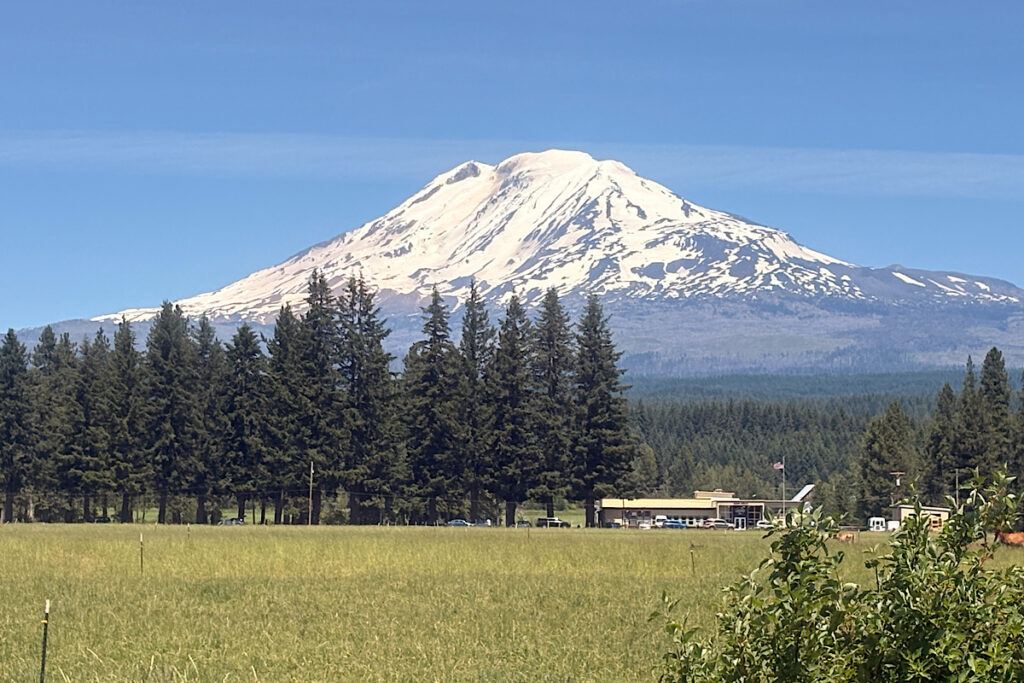
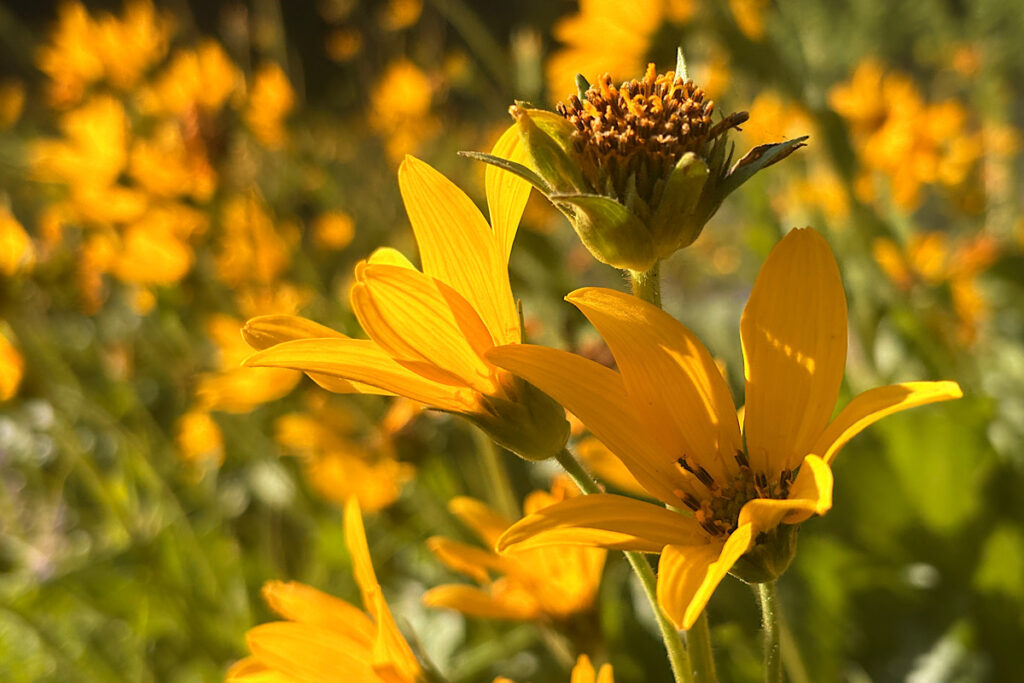
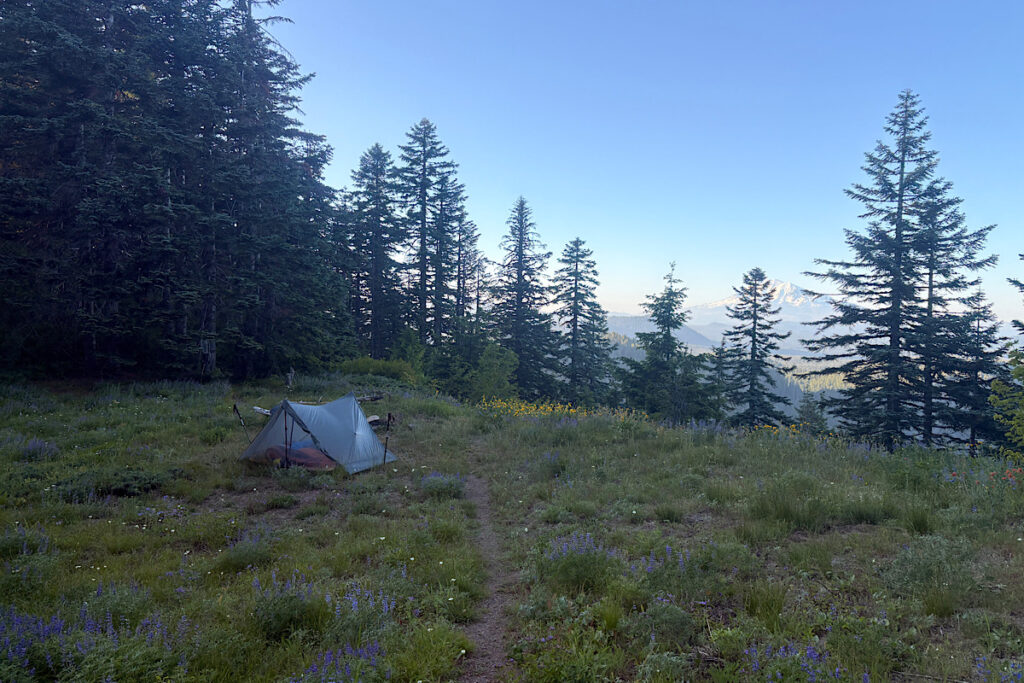
We camp Saturday night on a high alpine meadow with an amazing view of Mt. Adams. The area is full of Carey’s balsamroot (Balsamorhiza caeyana) and mountain lupine (Lupinus spp.). The balsamroot is found mostly east of the Cascade crest and is eaten by both deer and elk. Local tribes eat the shoots, seeds, and taproot, though it requires lots of cooking to avoid indigestion (again, I’ll stick to trail mix). Lupines are a common, though beautiful, wildflower throughout the West. As members of the bean family (Fabaceae), they are capable of nitrogen fixation and are therefore important early pioneers in areas lacking soil, like around Mt. St. Helens post-eruption.
The hike out Sunday morning is almost entirely downhill through second-growth forest. The air is warm, but the mosquitoes are non-existent. There are few water sources along the way, which means we have to carry our day’s water, but the hike is so easy, we don’t mind. We bump into a couple of Germans who have just crossed the Columbia on their northbound (NOBO) thru-hike of the PCT. I want to pepper them with questions about their route and their gear, but I can tell they are anxious to keep moving. After a few minutes, we go our separate ways.
The forest here actually reminds us quite a bit of the San Juan Islands. Bushes of ocean spray (Holodiscus discolor) dot the forest floor.
We finish our hike at Panther Creek around 1pm. The creek is cold and clear. We take one last dip to remove what remains of the trail from our skin before hopping in the car for our journey home.
We haven’t decided on the next section, but if conditions are favorable, it would be nice to hike the 65 miles from Rd 23 to White Pass. This would take us through the heart of the Goat Rocks Wilderness and the highest section of the Washington PCT. Snow will be the issue there, though it was a mild winter. Climate change may be our friend with that section.
Bets
Living vicariously! Thanks for the story. Keep on puttin’ one foot in front of the other!
womoses
Right on, Bets! Hope we can all get out on the trail together before too long 🙂